Outsider CEO #1: Tom Murphy and Dan Burke
This is a chapter #1 summary of The Outsiders, a book about 8 outperforming CEOs that all did NOT follow a conventional path, and strictly and utterly outperformed their competitors, often by a very significant amount.
——————————
Tom Murphy (and Dan Burke) basically used a 2 prong approach to grow. Operational Efficiency and Selective Acquisitions.
Cut all unnecessary costs out of the business, but correctly invest heavy when something crucial is required. Make the business supremely yet sustainably profitable, with a sizable economic moat. Focus heavily on free cash flow.
Stay decentralized. Find the best people, and get out of their way. Let them be so free that they paradoxically never want to leave. No middle management, and no fancy unnecessary corporate perks.
Ignore the media or other people, but learn constantly, continually crafting your own judgment. Do not issue stock to fund purchases, which would lead to a loss of control. Be fearful of long-term consequences. Use debt instead, and buy up other struggling companies that can be improved (via said operational method listed above). Your focus on FCF (free cash flow) will allow you to confidently service the debt.
On acquisitions, approach with a disciplined, but generous spirit towards the seller (build your preferred buyer’s reputation for easier further acquisitions—- most of which you’ll still say no to). Talk to people directly, and sometimes for years before a sale happens. 95% patience, 5% hellacious, game changing aggression.
Inherited Meaning
Beginnings are special moments in any situation, because everything can change then. After things have been established for a while, nothing will change until the situation materially fades away. Some examples:
Changing jobs lets you cash in all of the social skills you learned, establish a new work identity, and get significantly higher compensation. It doesn’t matter whether you were forced out or chose to leave. If you stayed, you’d get a minimal annual raise, and everyone would see you as ‘that person who’s stuck in that role’, your reputation sticking to you like glue.
Changing relationships lets you restart things fresh, establish new boundaries you either didn’t know or forgot to establish, to set up relationship dynamics in a way that satisfies you. It doesn’t matter whether you were the one doing the breaking up, or were broken up with. If you stayed, the potentially random dice roll of events may be your fate forever, consigning you to the level of learning/skill you have outgrown for years.
People in general cling too hard to situations that are really no longer serving them, justifying their fears of conflict, embarassment, uncertainty, and other unpleasant emotions by maintaining the status quo. They delude themselves, telling themselves “things will change,” even though there are usually signs things never will. The attitude to intentionally initiate the change or conflict on their own terms, brace for the suffering that comes, and summon the conviction to fight through to the end would serve them much better.
But there is one place in life where this attitude cannot work, and it really is best to make the most of the situation—- your own psychology.
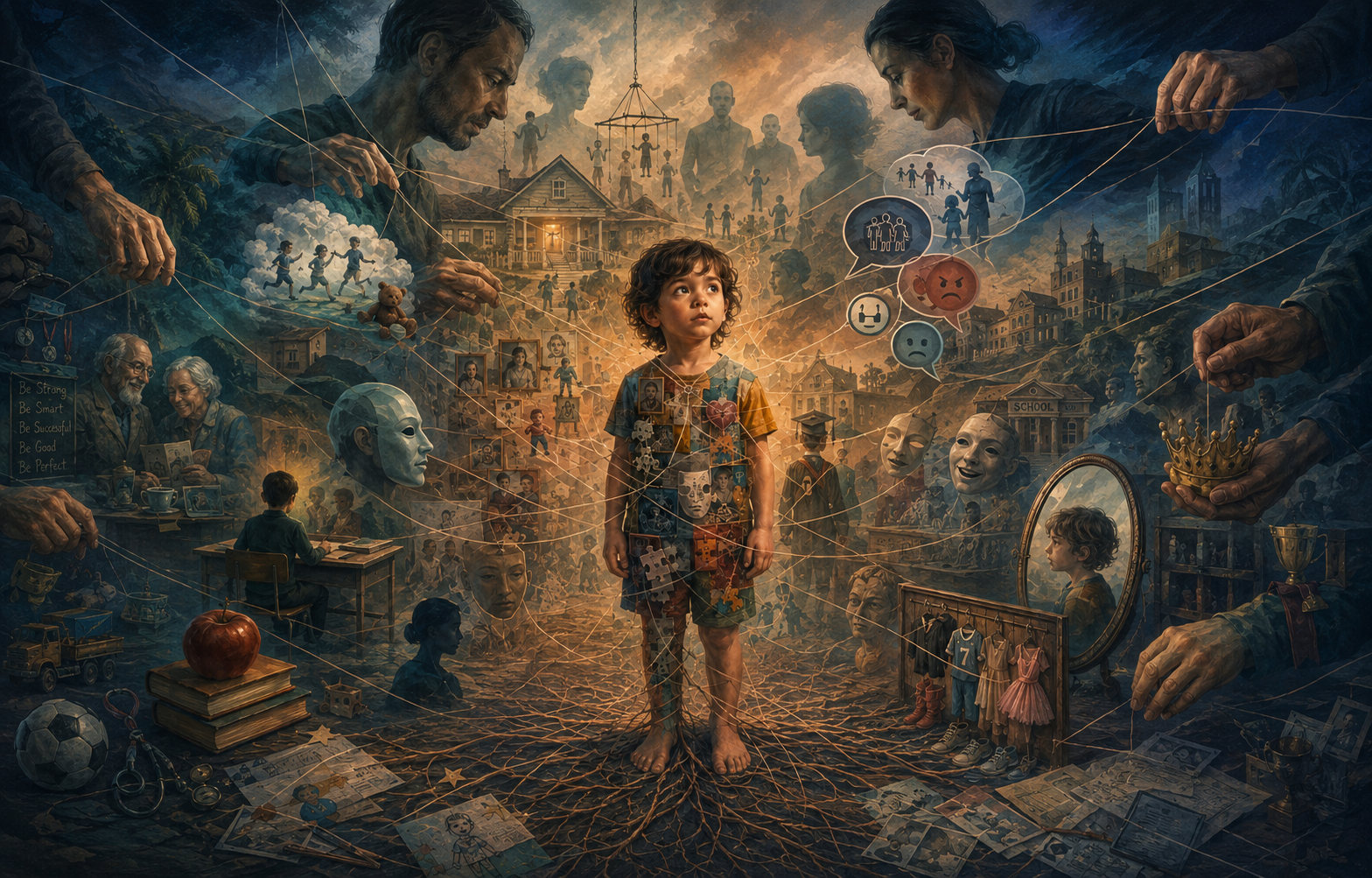
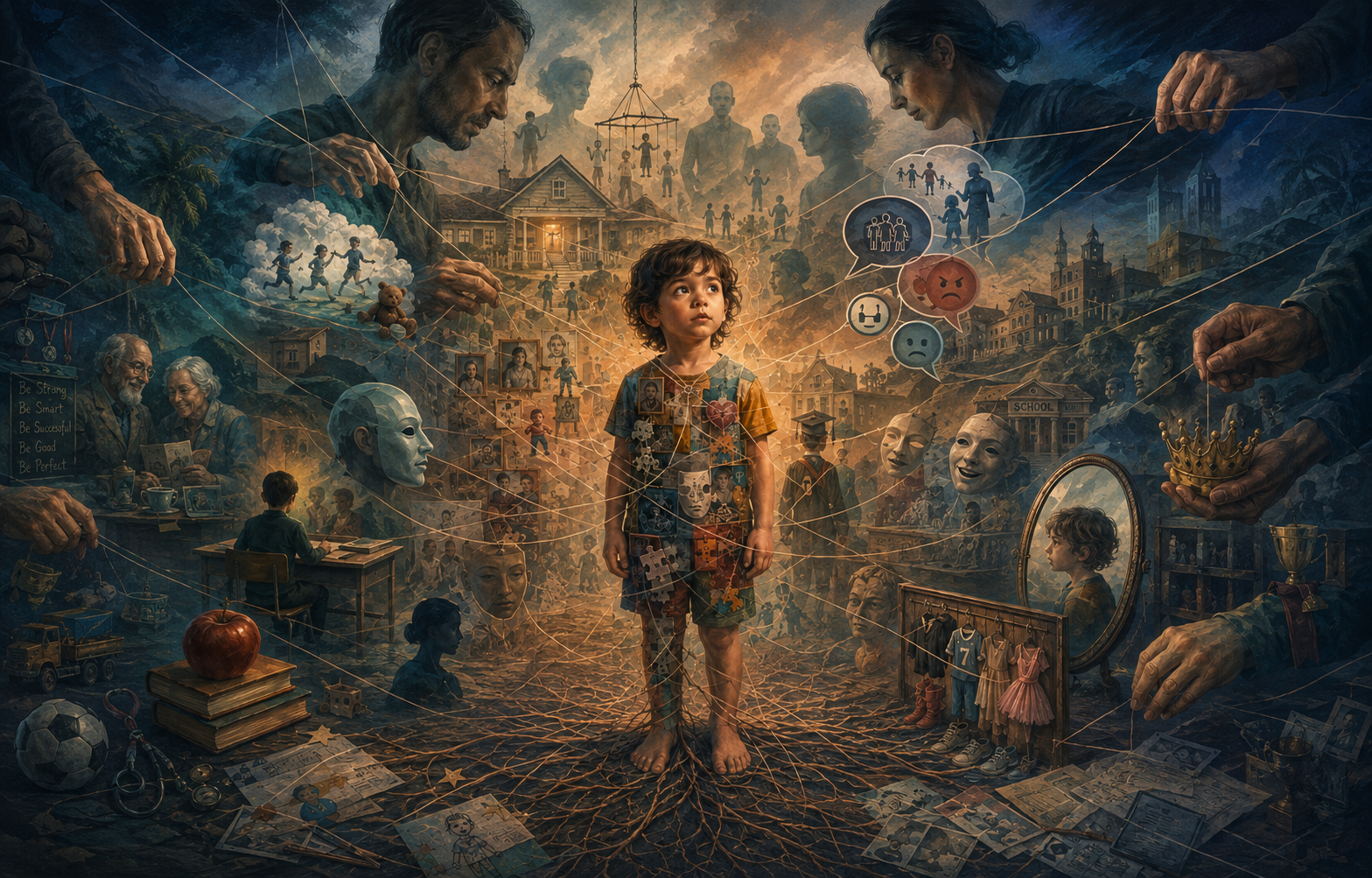
When you are a kid just growing up, several very important dice are thrown in your life, and to an extent, they write a part of your fate for the rest of your life. They make up your character, your emotional disposition, your self-image, and more. They directly influence how you interact with the world, how you show up in various social situations, how you dream, how you cope with suffering. The combination of psychological forces that press in upon you as a child becomes your Inherited Meaning, a unique blend of your personal emotional and mental traits.
Because of how impressionable you were as a kid, the influence of Inherited Meaning in your life is particularly profound. It generally cannot be overridden or changed in a long-term or permanent sense. It can certainly be disguised, masked, repressed, etc., but this is a stressful, exhausting, and generally unsatisfying path to stay on for too long. Forced to, or choosing to repeatedly go against this current of Inherited Meaning means to swim upstream, either suffering as you do so, or failing to fight the current, and being pushed downstream anyway.
Because Inherited Meaning is a beginning that you cannot restart, it is best to use this constant force in your life to your advantage, and not waste time and energy fighting against it. Think of Inherited Meaning as a psychological current that will repeated push you to follow certain paths, react in certain ways, and feel certain emotions time and time again. To the extent you can, this is one thing about yourself you should not just accept, but accept wholeheartedly.
What is the exact character of your Inherited Meaning, to the extent you can clearly define it?
What direction is your Inherited Meaning constantly pushing you?
What positions or stations in life would be well suited for someone of your nature?

Applying the Levy Walk

There is a pattern present in many species including fish, dogs, and even microscopic organisms. It exists both for seeds of plants not yet sprouted and herds of animals traveling together. It is a pattern that allows them to search for resources across a sparse environment, despite not knowing where the resources they seek are located. This pattern allows for maximum search efficiency, increasing the chances for survival and expansion. It is also present in humans.
This pattern is known as a ‘Levy Walk’, a random alternating pattern that switches between short-range searching, gathering, and exploiting a small area (called ‘Levy Exploits’ here), and long-range, straight line movements to new areas (called ‘Levy Flights’).
Even though this pattern is found across several different species and environments, it occurred to me that due to the nature of modern life altering our behaviors, it could very well be that we’ve found ways to deviate from this natural pattern, and not for the better.
There are two major ways to fail to uphold this natural pattern:
Conduct a Levy Flight too early (jumping away from what would be the fruitful remainder of a Levy Exploit), or
Stay too long in a single spot, long after a Levy Exploit has yielded any potential resources
What culprits might we identify for jumping too early? I’d venture technology, advertisements, or social pressure to change directions could all mistakenly cause a badly timed Levy Flight. Anything that suggests a ‘quick fix’ during a difficult time could pull one out of something that was otherwise worthwhile.
And on the other side, what culprits might make us stay too long in something that isn’t working? I’d say social obligations causing a Levy Flight to appear too costly (via conflict, guilt, etc.). Tradition and history may be another thing weighing you down.
To do:
Conduct a review of the different areas of your life, from the perspective of the Levy Walk.
Is it better to continue exploiting, or is it time for a jump?
Summary:
Problem: You feel like you spend all of your time and energy searching and never really benefiting from what you find. Or oppositely, you’ve been in the same place for too long, and there’s no living spark where you are. You end up feeling trapped by your routine, your circumstances, your pattern. This feeling could be in your work, your relationships, your hobbies, craft, or even religion.
Takeaway: Examine where you are in the Levy Walk and consider if that’s the right position for you. Take account of what you’ve seen, select the best place to drill down, and commit to doing just that. Do not change positions until it becomes clear there is no more benefit to be gained in that place. Oppositely, search for new horizons and adventures. Push past the fear and social pressures that likely hold you back from completing your search.
The Mental Operating Loop
Across any person’s lifespan, all mental activity runs in a cycle. Let us call this cycle the Mental Operating Loop, which is comprised of Components.
Since the Mental Operating loop is present in all people, and often subtly but significantly influencing us, always running in the backgrounds of our lives, we should strive to pay special attention to its structure. By examining closely this loop and the operations that occur, we can detect issues and risks, correct faulty components and patterns, see fantastic opportunities, and even better connect with our fellow humans as we recognize them operating in the same loop.
Components of the Mental Operating Loop:
Perception
Model of Reality (creates Meaning, creates Possibilities)
Analysis (creates Options)
Decision (chooses 1 Option)
Execution (carrying out Option)
Result (can feed into Perception)
Basic Operation:
First Perception occurs, then a Model of Reality is created.
Analysis is performed, creating Options from the Possibilities inside the Model of Reality.
A Decision selects an Option, and Execution carries that Option out, creating a Result.
This Result can then enter perception, restarting the loop.
Note: All components are recursive and can enter Perception. Multiple loops can be running simultaneously. The Components can change order and interact with each other endlessly.
Perception
Everything the person perceives enters perception, including internal and external stimuli all enter the mind, but not everything is noticed. Human perception is heavily filtered.
Examples: hunger, thirst, other people’s aura/energy, that thing you have to do later tonight, a coworker getting mad at you, returning to work on monday and subsequent dread,
Model of Reality
The model of reality interprets and creates Meaning via connections, and takes into account the following inputs:
Filtered Perception
Beliefs
Memory
Identity
Emotions
Incentives
Meaning is generally created by emotionally resonant connections unconsciously made between inputs inside the Model of Reality, combinations of the above bullet points. It’s something the person experiences, or doesn’t experience. This is typically not actively done; the person either realizes it exists or doesn’t exist.
Meaning is never guaranteed (the default is not having Meaning), but human beings continually search for Meaning as a fundamental need. People with Meaning in their lives do much better than people without it, who literally go crazy.
The quality and quantity of Meaning is specific to the person in question. Meaning is highly, highly individual.
At this point in the loop, Meaning is a complete hallucination. It can be actually present in the real world, but that’s not required. It can also be shared as this hallucination version to other people, with no connection to reality whatsoever. (a complete delusion)
From the sources of Meaning in the Model of Reality, possibilities are created as an output.
Possibilities are Meaningful single or combined inputs (a bullet or bullets from above, or mini-Model of Reality). Remember, since components are recursive, inputs can also include mini-Models of Reality.
Examples:
Feeling excited about getting to see someone you know, and thinking of the possible directions life could take after that meeting
Becoming nervous about the task ahead of you at work, and what it means for your career
Seeing the connection between a place you used to live and a pattern that’s followed you for years across your life
Not knowing if an article or book you read chose you, or you chose it, but knowing deeply that the message it contained connected to something significant in your life
Analysis
The Model of Reality creates Possibilities to consider. Analysis cuts these possibilities down to Options we more deeply consider. There are generally fewer Options than Possibilities.
Typically, Options pair a Possibility with a potential Response.
Responses include actions, reactions, and can also include doing nothing as a reaction.
Example:
For this, picture a kind of electronic screen, showing only the relevant Options and all of their components
The Options are listed on a menu top to bottom, going down the screen for you to pick from
The ramifications of each Option show up, forecasting the future to the extent you can foresee it and to the extent each one can be predicted
Decision
A Decision chooses one Option from the Analysis component.
Other Options are excluded, but a second (recursive) round of Analysis can combine or change Options.
Not choosing any Option is also a decision.
Example:
One of the Options above takes precedence above all others, it’s details and next steps expanding to fill the screen
Execution
This is the act of carrying out the chosen Option.
The mechanics involved in pursuing an Option are also recursive, and can also enter Perception.
Example:
The next steps involved in actually bringing about that Option are brought into focus on the screen, and any progress related to the actions taken begin to spring forth
Sometimes execution isn’t really relevant; some Options are more decisions to be made than steps to be taken
Result
Either the inner or outer world of the person in question is affected, and this Result enters the person’s perception, restarting the loop or creating a new loop.
The decision component is the area where you can control this loop. You’ve perceived this information and added it to your Model of Reality. Now, you can edit your own loop at will.
Take a moment to consider the gravity of this: any situation contains infinite possibilities that you can pursue, so long as you believe in your own agency and act on the things you perceive. This means quite a few (though not all) situations in life can be altered to fit your plans. Life, to an extent, can be shaped at your command.
Visioning and Improving
I’ve got two major visions so far for this new writing project of mine:
Create a backlog of things I actually want to write about. These are the reasons for wanting to writing at all.
Learn deeply about how to write. Build out a foundation and toolkit so I can more clearly express the ideas.
I think the order listed above invites lots of practice runs, with the expectation that early iterations will be of relatively poor quality, despite full efforts. Only when I know where I actually commit errors will I know where to spend improvement efforts.
#2 will be largely tackled along the way, as I learn to build my own formulas for writing. Internet resources and workshops will help, but it has to come from me. Copying and pasting someone else’s formula wholesale is not unique.
But enough meta-writing, let’s move on to the main course, the scariest part: Expressing ideas I believe humanity should stand to benefit from.
Vision Criteria:
Visions should be a ‘perfect’ user guide, providing immense benefit to the user, representing the standard of how that faculty, dynamic, or situation and should be approached. Notes will definitely be made where reality forces the user to deviate.
Visions should be extremely available to everyone:
No resource requirements to using them, other than reading and applying what I wrote
Applicable to people of all backgrounds
Visions will be presented as neutrally as possible (amorally)
Focus will be on describing the situation as completely as possible, including:
Roles
Mechanics/dynamics
and actions that progress or regress the user’s position/status/results
All of this section is subject to change
Vision Backlog:
Self-Awareness/Metacognition (awareness of your own emotions and thoughts)
Self-Change (enacting the changes you want, without going against your own nature)
Attention Control
Identity Control
Long Term Thinking/Planning
Your Lifetime Happiness, Forecasted
Meaning only shows up sometimes. You can’t count on it.
[more to come!]
First Post
"If you want to have good ideas, you must have many ideas."
– Linus Pauling (also on Paul Graham’s site)
I’m inspired by Paul Graham and all that he’s accomplished, despite being so unique/weird. And now with Sam Altman coming out of Paul and Jessica’s Y Combinator and leading OpenAI, I can only say that his approach made more than enough sense.
What is his approach, and why is it such a big deal? I’ll explore that soon. But I think it’s something to keep in mind in all walks of life. For now, just trying to get this website up and running, and start creating some legacy to leave behind—- hopefully it’s a positive move.